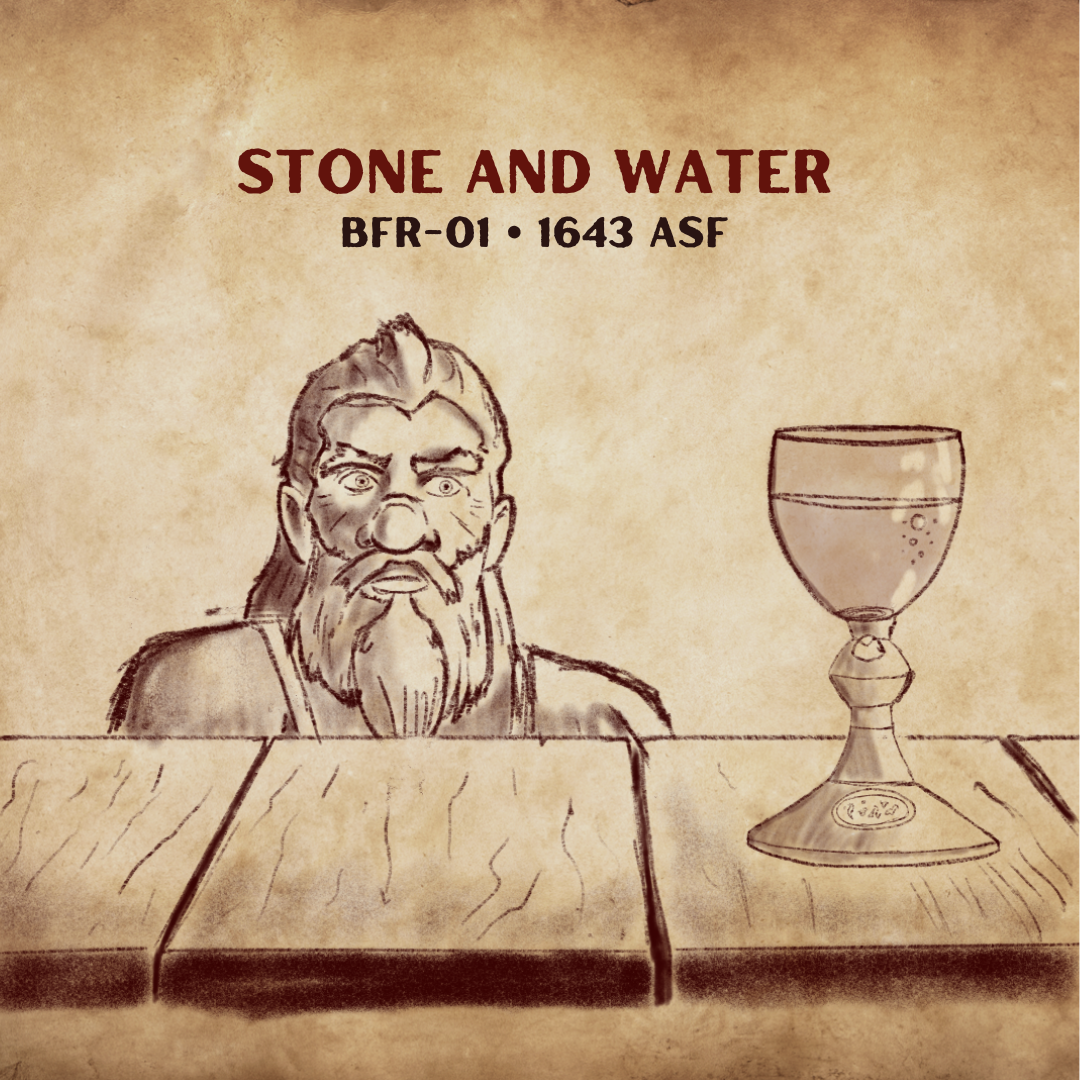
The dwarves of Buried Forge hate water.
This is not simply a euphemism for how much dwarves enjoy their beers. Something about the dwarvish body wholly rejects water in its pure form, treating it as a poison. Even just a swig is enough to trigger a dangerous fit of coughing and gasping. Ingesting a cup of water can outright kill a dwarven man or woman, a drowning on dry land. In fact, some especially sensitive dwarves break out in rashes if water touches their skin, whether that is from ocean spray or the sneeze of a non-dwarven friend.
Knowing this, it is easy to understand certain aspects of dwarven culture. Dwarves do not swim or bathe in water. They build their homes and lives underground, amongst layers of dry stone and rivers of magma—about as far as you can get from water. The few merchants and mercenaries who roam the surface world distrust the sky, fearing a sudden squall. They look upon the great, shimmering depths of Lake Liron with horrified awe.
With so little dwarves leaving their undermagma city of Buried Forge, much of their culture and civilization is an enigma. Not many, for example, know that Buried Forge is actually a remote colony, one connected to a vast subterranean empire far beyond the maps of Avelliron. There are precious few accounts written on the gristermhil, an expansive web of underground railways connecting all imperial settlements—including Buried Forge—with trains powered by fresh magma. And so much remains unknown about Unghorlum, the imperial capital, perched in a molten lagoon and criss-crossed by thousands of lava canals.
I’m getting ahead of myself. Before we can truly explore the wonders of dwarven civilization, we must understand what it means to be a dwarf—and that means an instinctual aversion to water.
Nobody is quite sure why dwarves disagree with water. Perhaps it is due to their cycle of life. Dwarves do not produce offspring, after all. Dwarven children are mined out of the earth, excavated from shale like precious gems. Contrary to what you might be thinking, the “miners” do not become the child’s adoptive parents. Instead, the child is handed off to a dwarven clan, which raise it collectively alongside many other children.
All dwarves in a clan belong to the same deposit of stone. From the clan, many elements of dwarven culture are derived: social status, marital matches, profession opportunities, as well as wealth and political power. Born to the right clan, a dwarf might one day become an advisor, master blacksmith, or councillor—or, in the wrong one, be doomed to shovel slag pits.
There are thirteen major clans alone in Buried Forge, but these each divide themselves up further. They care about where, exactly, a dwarf was mined in the clan’s layer of stone, but also the surrounding stone’s characteristics, such as toughness, purity, and color. And if there any precious stones nearby, those have different meanings and omens on the child’s personality, luck, and future.
Among the clan’s many duties is the burial of its clanmates. When a dwarf dies, they are thrown into great currents and lakes of magma, deep underground. From here, dwarves believe their kin travel through these boiling veins of lava, winding through the earth before finding their way back to a deposit of stone, where they are born anew.
Indeed, dwarves are a people born of stone, and perhaps this explains their aversion to water. Like the canyon and the river, or the ocean and the cliff, dwarves and water simply do not agree.
But what about all the beer? Isn’t that made from water? Well, yes. But dwarvish brewing is a special process that makes it safe for them to drink, along with imbibing it with that distinctive, earthy flavor. In recent years, brewing has expanded into other drinks, including coffee and tea.
Indeed, dwarves will drink anything—as long as it isn’t water.