If the tale of the Wanderer has taught us anything, it is to never come between a Yulekk and their stick.
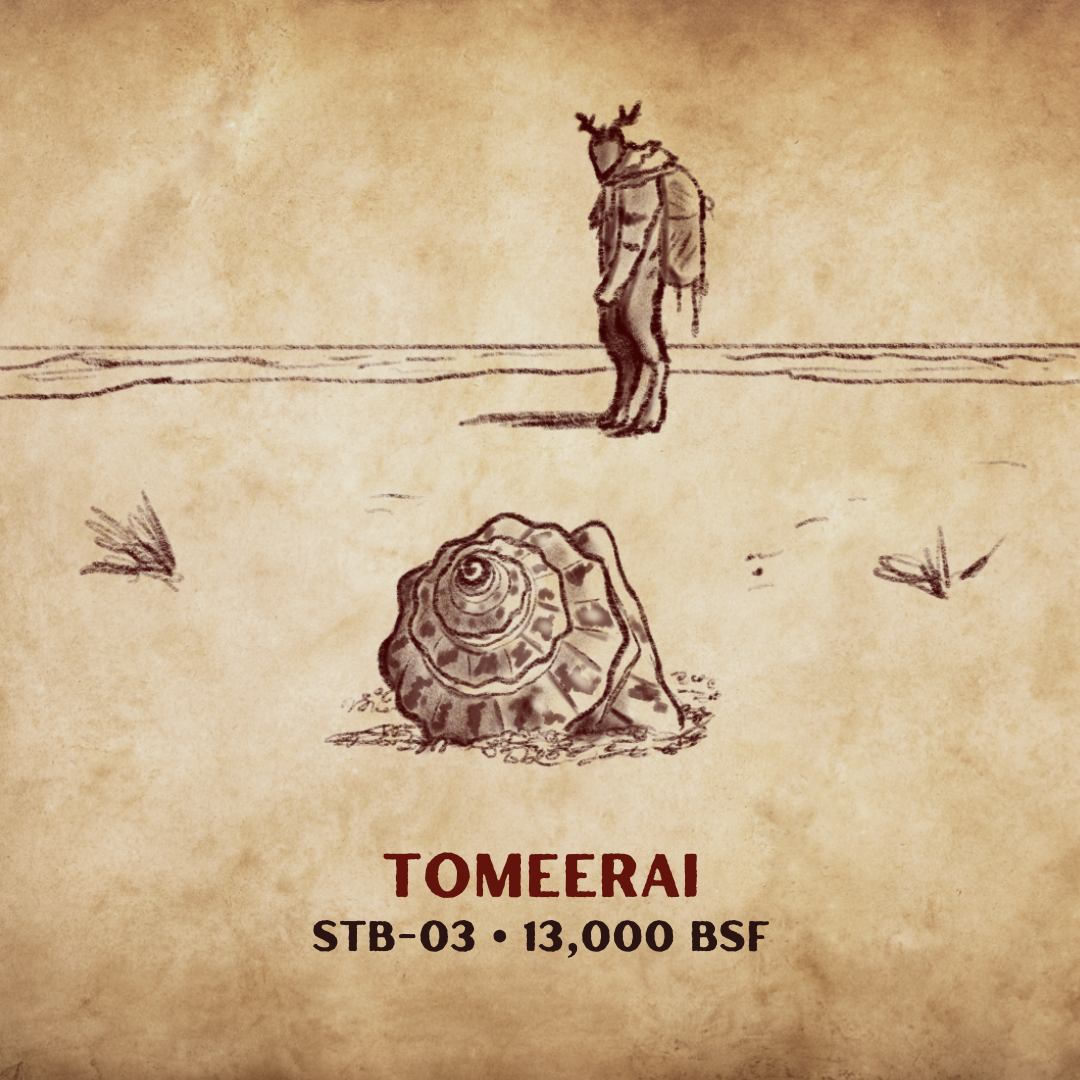
Or, more appropriately in modern times, their tomeerai, a word that roughly translates to “an object found at the end of a long journey.” Indeed, upon reaching adulthood, every able-bodied Yulekk embarks on a journey that pays homage to the legend of the Wanderer. It is a search for their tomeerai.
At the end of winter, before the Yulekk depart the warmth of the geyser fields, there is a great celebration. All tribes partake, pushing forward their kin who have had second antler-fall within the last year. These new adults are paraded around, showered in charms and blessings and rites. They are brought before the great chieftains, where they swear to bring home something worthwhile. And then, as the first flowers bloom, they are turned out into the world with one task. Find their tomeerai before the last leaf of autumn.
There is no official criteria on what a tomeerai can or cannot be. After all, the Wanderer brought Stelgur just a simple stick. That is a popular choice for tomeerai, of course—sticks, twigs, and branches gathered from faraway lands. So too are rocks from deep caverns and shells from distant beaches. Trinkets from foreign markets or relics of ancient ruins. It can truly be anything.
What matters more is how difficult it was to obtain the tomeerai. The tougher the challenge, the riskier the attempt, the farther the distance, all the better. It makes for a better story, you see. For example, none will ever forget the trials and tribulations of Sotapu the Swift, whose tomeerai was a crown!
(Note—Sotapu’s heroics allows Lorekeepers to ascribe a date to tomeerai tradition. Her crown belonged to the Orlott, who angrily recorded its theft somewhere around 13,000 BSF).
But because there are no rules on tomeerai, every Yulekk approaches the journey in their own way. And not all wish to partake. Some seek out the closest small hill. Others purchase something foreign-looking from a traveling merchant. A few seek exemptions or ignore it outright, although this is like to earn them the scorn of their tribe.
The majority of Yulekk recognize the journey for what it is and what it will prepare them for. They set forth with the curious and committed spirit of the Wanderer, following naught but wind and wave and whim. It is why, to this day, you can find Yulekk in the most strangest of places, looking for their tomeerai.
At the end of autumn, they return to their tribes in the geyser fields of Stelgur’s Breath. The festivities are even greater than those in the spring—capped, of course, by the offering of the tomeerai, placed first and foremost on the tribute to Stelgur. Their Wanderer’s journey is then complete, and it pays for warmth and safety through the long winter ahead.
Now, you may be wondering: what’s to stop a Yulekk from lying about where they got their tomeerai? Well, for one, the Yulekk are intimately familiar of the lands in and around Stelgur’s Breath—down to very stick and stone, I’m told. They can quickly tell if someone is passing off something local as something foreign. The punishment for such an act is most severe.
But if a Yulekk is lying about their tomeerai, and if they manage to convince others to believe in their fictitious journey to retrieve it… well, they’ve just proven themselves a potent storyteller, have they not?
And this, you understand, is worth something in Yulekk culture.