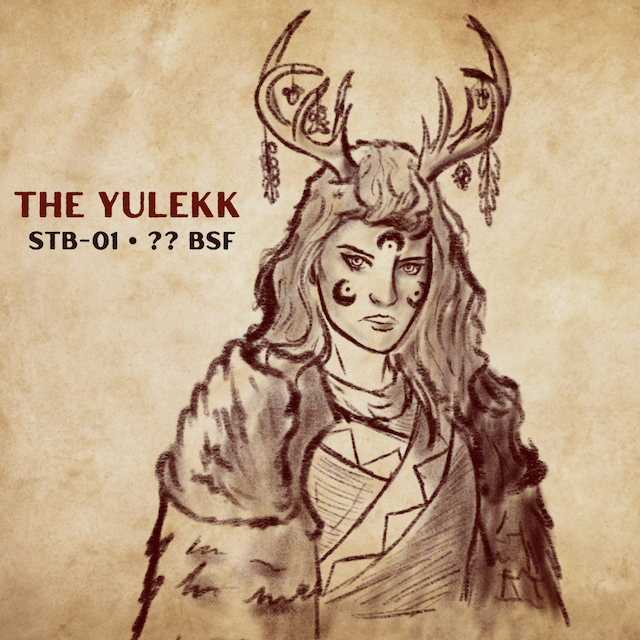
To understand the Yulekk, the nomadic people of far north Avelliron, you must first understand their antlers.
To be fair, there are many things that set the elkfolk, as they are more commonly called, apart in a crowd. Pale blue skin, eyes that darken in color during the winter, clothing crafted of warm furs, and hoofed feet. But much and more of their culture hangs (quite literally, as you will soon see) from their antlers.
Every Yulekk—every man, woman, and child—possess a set. And while most antlers typically strike a brilliant white color, no two sets are truly alike. Some spiral and twist, while others jut out as proud and tall as a crown. Beyond natural shapes, some Yulekk carve their antlers into intricate forms, whether for tribal association or personal expression. Others ornament them with colorful feathers, spin webs of yarn between points, or hang jewelry or charms from their branches.
No antlers last forever, though. A Yulekk will go through seven or eight sets in their life, averaging about one per decade. The first set sprouts shortly after a child is born, growing with him or her until about age ten. At that point, much to the bewilderment of the child—and the amusement of adults—his or her horns simply slide off with a soft pop! Having seen this myself, it’s akin to a baby tooth falling out, but far more dramatic. Marking the halfway point to adulthood, it will take a year for the next set of horns to grow to full size—a state of being that many Yulekk find awkward.
When the second set falls off, about a decade later, there is much fanfare and rites taken, for it marks the passage into adulthood. Indeed, antler-fall is a recurring milestone in a Yulekk life, marking not just age, but experience and wisdom. From this, customs and traditions abound. For example, many Yulekk tribes simply won’t accept a chief who hasn’t yet shed his third set of antlers. Marriage is forbidden if one person has shed more or less than the other.
But what about the nine odd years between antler-fall? Upkeep. Their antlers need lots and lots of constant upkeep—treating cracks, oiling surfaces, and polishing points, for example—and it’s not easy to do individually. Nor quickly. This equates to much time spent around the communal fire, as family members tend to one another. And they fill this time by talking: whether it’s dealing with business, sharing knowledge, or churning the rumor mill. Most important of all, with all of this time they spend together, Yulekk tell stories. They weave tales of great battles, heroic sacrifices, and the fearsome creatures that stalk the white wilds of Stelgur’s Breath.
This custom stretches back thousands upon thousands of years. The Lorekeepers believe it’s the foundation of Yulekk oral tradition—why they prize stories so highly, going as far as to weave them into elaborate blankets. Indeed, we have these traditions to thank for much and more of the lore assembled in the Conservatory. The Yulekk were spinning stories long before Starfall, long before even the great Orlott civilization rose to power.
But the Orlott empire collapsed, and the Yulekk—and their antlers—endured. They hold stories that the rest of the world has forgotten.