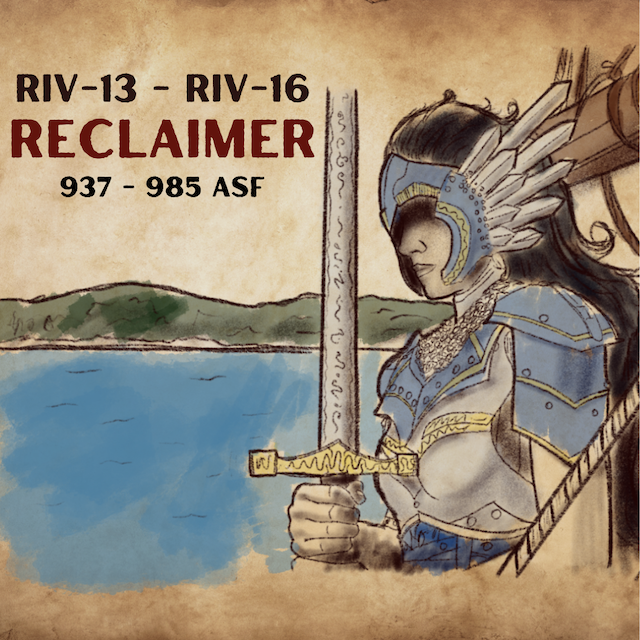
There was once a girl who was raised by the rivers and ravens.
Not once in her first five years of life did she question why this was. Why would she? The girl had everything she needed. Handspun clothing. Food foraged and hunted from the wilds. A cozy hut tucked in the shadow of a great willow tree. A steadily growing collection of pebbles, sticks, feathers, and strange treasures scooped up from the riverbank. As much freedom as she dared.
And, of course, Birdie.
Birdie was not the girl’s grandmother, but she certainly looked the part: black hair, thin and crispy; wrinkles around her hawkish nose, her skin pale, spotted, and veiny. Always dressed in a patchy black cloak tangled with leaves, twigs, and feathers. Always hobbling around with a staff hewn from a thick willow branch. She acted the part of grandmother, too, caring for the girl in all respects, teaching her the names of things and how to live in the wilderness of Rivona. Indeed, Birdie was the girl’s entire family. The girl did not have parents, or siblings, or even a name.
Birdie was also unlike a grandmother in many ways. She tasked the girl with odd errands and no explanation: to search for river stones in specific shapes, to weave baskets to push into the river, to catch insects and pull off their legs. As often as possible, she made the girl balance on a floating log each and every day—first on her bum, then on her knees, then on her feet. After that came the makeshift boat challenges.
Birdie often left, too. She disappeared without a word and returned with just as many. Sometimes she would vanish for an hour, sometimes half a day or more. The girl grew used to this and soon learned to entertain herself with all the skills Birdie had taught her. She became a creature of the riverlands, venturing further and further away from the willow hut. Some days she would climb trees, sing into the wind and listen to what sounds returned to her. Others she would row the misty backwaters with her little raft of reeds. And over time, she came to know the strange wilds of Rivona as few have.
I have heard this girl’s story plenty of times before, but I never once appreciated just how lonely and eerie her world was—not until I experienced it myself.
Mind you, I did not enter that world out of choice. It was more along the lines of desperation, fear, and a burning desire to avoid eating my own boots for dinner. See, after the business in Angler’s Arch, wherein I spoiled the town’s favorite tradition of lynching riverbirds, I wasn’t exactly welcome anymore. But I had no traveling supplies or money to buy some, and I had exhausted all my options for work. I didn’t even have a place to sleep. My only real possession was Kerraguard Exemplar, a book gifted to me by the town’s guard captain. One I continued to read during every spare moment, even as my stomach growled.
So you can probably imagine my relief when a herthe pulled into the riverfront docks. I knew from my study of Rivona that herthes were a type of merchant ship specializing in transporting goods throughout Rivona’s waterways. Merchants ships always needed an extra helping hand. Wading around the crew disembarking the herthe, I found the captain and her first mate speaking on the docks.
From her accent, I placed her as a Faelan woman, standing a head shorter than me with hawkish eyes and wild honey-brown hair. Her first mate, however, spoke the flat, curt quips of Khorvish and, from my position, was as tall as a mountain. Most of his face was buried in beard. At my approach, both he and the captain quieted and turned towards me.
That was when I realized I wasn’t the only one with this idea—another man, somewhere around my age, had walked up beside me. Newke. He opened his mouth before I could, spilling out a tale of tragedy to the captain and the first mate, something about gambling at the Raven’s Nest and losing all his money, with his wife and job following shortly thereafter. The captain just shook her head at this. Too many details. She didn’t care. As long as Newke did his work, kept himself out of trouble, and didn’t ask questions, he was welcome aboard.
The captain lifted an eyebrow at me, to which I asked a simple question. No questions? Indeed, the captain grinned, pleased that I was already learning the ropes. She didn’t even want my name—which I found odd, but then again it was probably for the best. We agreed on terms, and yet something about this whole affair unsettled my stomach.
Perhaps it was because of how little I knew. University folk don’t handle uncertainty well, after all. It really struck me when the captain returned to the ship and announced we would be departing “upriver through Crosswater”. Upriver? As the ship pulled away from Angler’s Arch, I realized I had no idea where we were going, what sort of merchant ship this was, and who the hells I was even working for. All I knew was that if we were going upriver, we’d be going through some of the most remote parts of all Rivona.
The very same parts that the girl and Birdie lived in.
Over time, as Birdie’s absences grew longer, the girl wandered farther and farther, both in body and in mind. She loved Birdie, her home, the wilds and all the creatures in it, but she began to ask herself: where did shecome from? Who was she? Where was the rest of her family? But Birdie only dismissed these questions.
Then, one day, while Birdie was away, a man and woman visited the hut. The man was tall and strong, his hair peppered with grey, while black hair spilled out of the woman’s hood. Both wore patchwork clothes covered in road dust. At first, the girl hid from the couple, as Birdie had instructed to do whenever she saw another person. But the man and woman called to her, claiming to be friends of Birdie’s. Curiosity drew the girl out, and when the couple saw her, they almost seemed to melt with relief.
The girl asked if they were her parents. No, they said. Did they know where her parents were? They did not respond to this, which the girl took as an answer in itself. Finally the girl asked if she could call them her parents. Throughout her questions, the couple had exchanged gloomy glances at each other, but at this last question, something between them broke. The woman squatted at the girl’s level, but before she could say anything, the man interrupted her and said Yes, you can.
And just as well. They hugged her, something Birdie had never done, and gave her gifts of food, toys, and clothes of the likes she’d never seen. When the shadows began to grow between the willows, the man and woman departed, promising to come back another day.
When Birdie returned, the girl told her everything. Birdie waved it off with her staff, and in fact seemed to have known about the whole visit. Sensing her hidden knowledge, the girl pressed again: where did she come from? Who was she? What was her name? Birdie tilted her head, telling her such answers were doors. Doors that, once opened, could never be closed. Did she want this? Yes, the girl demanded, believing she truly did.
So Birdie brought her to the river and told her everything.
The girl had a name. Relga. Relga of House Craythe, a royal line that traced all the way back to the first king of Rivona, Rugon the Ruthless. And the girl—Relga—was the very last of her line. Her family, her parents, her siblings…all were gone. Beyond the safety of Birdie’s hut was a kingdom about to crumble from within. Beyond Birdie’s willows was a world that wanted the line of Craythes permanently extinguished. Beyond also was a throne, a crown, a return of Rivona’s peace and prosperity—if only Relga was willing to reclaim it.
Relga was quiet for awhile. Hours or even days, perhaps. A bit much for a child to take in, don’t you think? After these revelations, the first words out of her mouth were another question: who was Birdie? How did she know all of this? At this, the old woman gave her a crooked smile.
Who was she, really, but an old crone? An old bird? A Raven?
It didn’t matter, except that Birdie had seen Rugon the Ruthless reshape the riverlands into Rivona. The realm needed another strong leader like Rugon to smash its enemies and secure its borders. And yet, the realm did not need another Rugon, for it was his brutal conquests and reckless warmongering that had sowed seeds of resentment and rebellion—seeds that had now grown into ferocious weeds that threatened to throttle Rivona to death.
This was Birdie’s condition. If Relga would swear not to repeat the mistakes of her ancestors, Birdie would help her through the long journey ahead. But she had to promise—above all else, no matter what happened—that Relga would not become another Rugon.
Relga promised.