LUM-03: The Drowned Knights
For all of Lumacia’s pride and glamour—for all its festivities and celebrations, all its independent spirit—you could be forgiven for believing the country had lived for ten thousand years, and would endure ten thousand more.
The truth, however, is quite different. Not only is Lumacia six hundred years young, it was nearly strangled to death in the cradle.
In the year 900 ASF, the peninsula was uninhabited. Certainly there were old ruins scattered across its cliffs and coastal highlands, but no ASF civilization had sunk roots into its soils. In fact, most people—witnessing how the sea swallowed the land bridge year after year—believed the peninsula to a cursed place, the domain of angry sea deities and their monstrous pets.
Superstition, however, is a luxury. One not affordable to the desperate and the destitute. And in 900 ASF, the Lumans became such a people.
Up until this point, they had lived as subjects in the kingdom of Nimboras. They had settled a string of fishing villages and towns along the Painted Sea, eking out a simple existence from sand and surf. Nobody yet called them Lumans, of course. Names of choice included those such as “water-witches” and “sea-swallowers”, bestowed upon them by inlanders.
You see, Nimboras has always been known for its unusually powerful storms. The tempests roll across the plains in a furious wave of lightning, hail, and, wind, sweeping aside all in their path. Half of these storms originate from the Painted Sea—and the inlanders, looking to assign blame for the damage, turn to the people that apparently worship the waters.
(Note: the other half of storms blow in from the Khorven Mountains. Nimborans likewise have derogatory attitudes and insults to the mountain peoples).
In 909 ASF, a particularly horrendous storm broke against the shores of Nimboras and raged across land. It is said that great funnels of water and ice descended from the belly of the tempest, uprooting trees, boulders, even small castles, flinging them for miles. Ruin and floodwater was left in their wake. The devastation reached even as far as the capital of Gusthaven, where the funnels tore through the walls and obliterated entire neighborhoods. By the time the storm abated, tens of thousands lay dead.
Such sheer devastation can have a way of shifting the collective mind of a people, instilling in them a concentrated will to seek vengeance. To hit back at something—anything. The Nimborans already had their scapegoat: the water-witches and sea-swallowers to the south (forgetting, of course, that the coastal peoples had been wounded by the storm, too).
If those coastal peoples loved the Painted Sea so much, then they could join it in a watery embrace! So the inlanders thought as they marched on the coast, intending to drive its inhabitants right into the Painted Sea. When a few early skirmishes proved the superior might of the inlander forces, the coastal peoples congregated, organized, and ran like hell, leaving behind their storm-swept homes.
They fled in the only open direction: towards the Tempest Cliffs, towards the Drowned Peninsula. Surely the Nimborans would give up the chase, they hoped. Surely their enemies would not chase them into a land long forbidden. But halfway across the narrow land bridge, they turned back and saw the torches of the enemy host trailing behind. The sight dashed their hopes, like the waves against the rocks. The Nimborans would soon catch them and slaughter them all.
And yet, they realized that the waves were also rising, crashing higher and higher with each passing hour. It was the beginning of bubble season, they realized, and soon most of the peninsula would disappear beneath the Sea. Indeed, as the waters rose, so too did their hope—and a plan for their salvation.
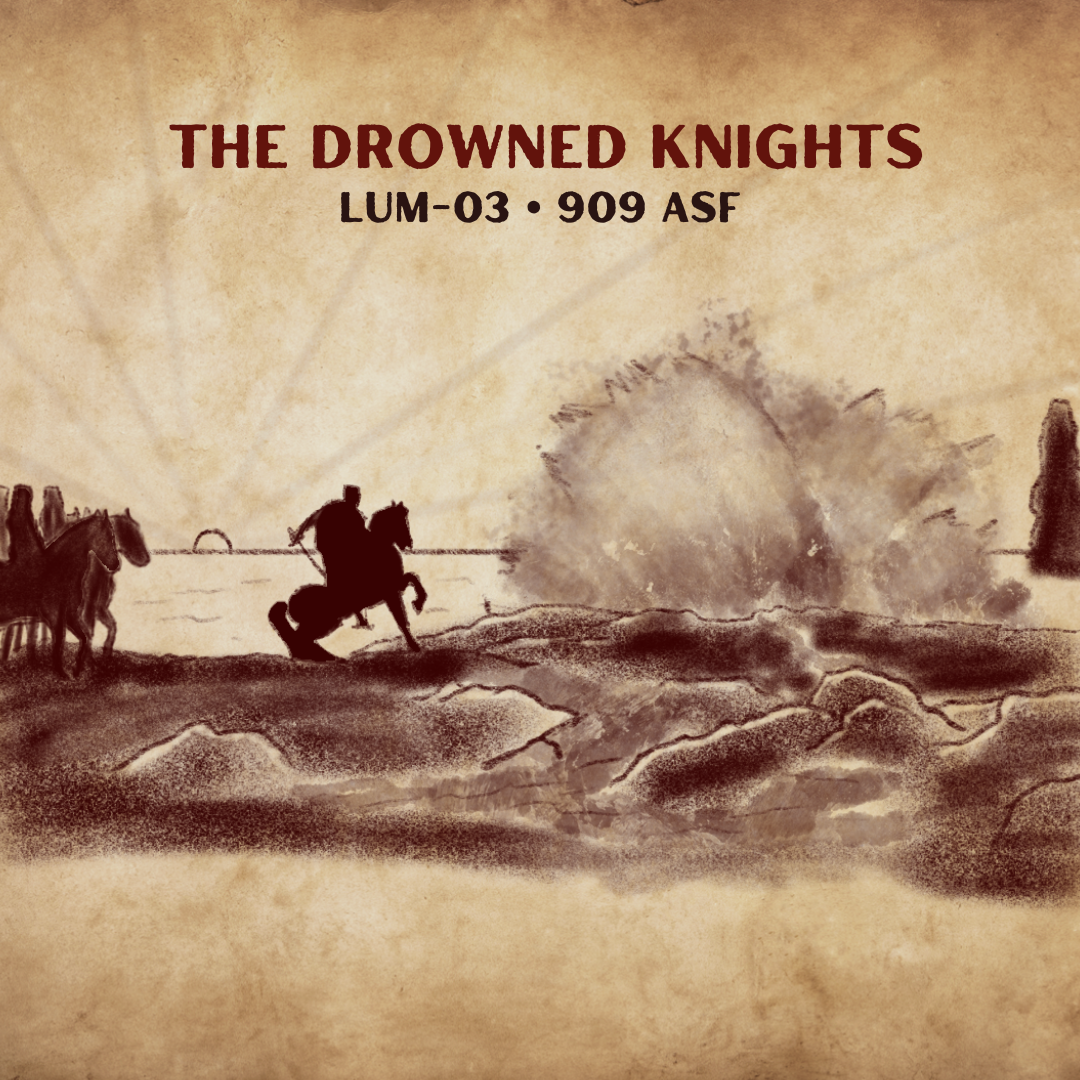
Eighty six knights, it is told, came together. Bidding their loved ones a final farewell, they mounted their horses and turned to face the Nimborans. Choosing the narrowest part of the land bridge, they hunkered down. They waited until the enemy funneled into that choke point—and, at the opportune moment, brandished their rusty swords and charged into oblivion.
They fought bravely, as the last sunset they would ever see fell over the Painted Sea. They fought valiantly, as great waves of water thundered against the stones all around them. They fought viciously, ensuring not a single Nimboran passed them by. They fought well until the night, until every last one of them lay dead.
Bards claim that when the sun rose the next day, the Sea had swallowed it all—the knights, the Nimborans, the bloody, rocky pass that had served as the battleground. A tumultuous gulf now separated the Nimboran army and the refugees, safe on the island. With no way to lay chase, the Nimborans turned home, content to let the cursed island have its way with the refugees.
Instead, a new country was born: Lumacia.
While we have no artifacts of the battle to corroborate this romantic tale of sacrifice, the Drowned Knights live on as eternal legends in the canon of Lumacia. Eighty-six statues stand vigil on the beach at August Cove, and nearly everyone in the country makes a claim of kinship to one of them.
They are above the kings and queens, to be sure. Through their courage—as parents tell their children at bedtime, and the water priestesses tell the crowds at a Summertide joust—Lumans were given a second chance.